

Julian Thorne
Crypto analyst and guide author. Making complex technologies clear for everyone.
How to Set a Take-Profit in Crypto Trading?
The cryptocurrency market is highly volatile: the price of any coin can skyrocket in a second and plummet just as quickly. In such an environment, to lock in profits before the price drops, you need to sit in front of your monitor 24/7, peering at the charts. This is where a take profit order comes in.
What is it? Simply put, a take-profit order is your personal command to the exchange, given in advance: "Automatically liquidate the position when the market price hits the specified target level”. Take-profit (TP) is a tool that ensures you don't miss a break, even if you're offline.

How Take-Profit (TP) Orders Work?
Taking profit can be compared to an alarm clock. You set it for a specific time, and it goes off automatically. In trading, you set a price instead of a time. Until the market reaches this level, your order simply "sleeps" in the exchange system, requiring no action from you. As soon as the market price "touches" your target, the exchange immediately places a sell order for your asset.
There are two types of TP orders: market and limit.
1. If it's a "market" order, the exchange will sell your cryptocurrency instantly at whatever price is currently available. This ensures you'll definitely exit the trade, but the selling price may differ from your target by a tiny fraction of a percent (this is called slippage).
2. If it's a "limit" order, the exchange will sell your coin exactly at the price you specified. This is more profitable, but if the price moves past your target too quickly, the order may simply not be executed.
For beginners, the most convenient option is the OCO (One-Cancels-the-Other) mechanism. This is a combination of two orders: a take-profit (for profit) and a stop-loss (for loss protection). As soon as one of them is triggered—for example, the price goes up and you take your profit—the second order is automatically deleted. This eliminates the need to manually clear your order list and eliminates the risk of an old protective order being triggered when you no longer need it.
How to Set a Take-Profit Order?
Now, let's look at how to set a take-profit order in practice. The logic is very similar on most exchanges: set a take-profit immediately when you buy cryptocurrency. Let's look at an example of setting a take profit on the Cryptomus exchange.
Right when you open a trade, you'll see a "TP/SL" checkbox.
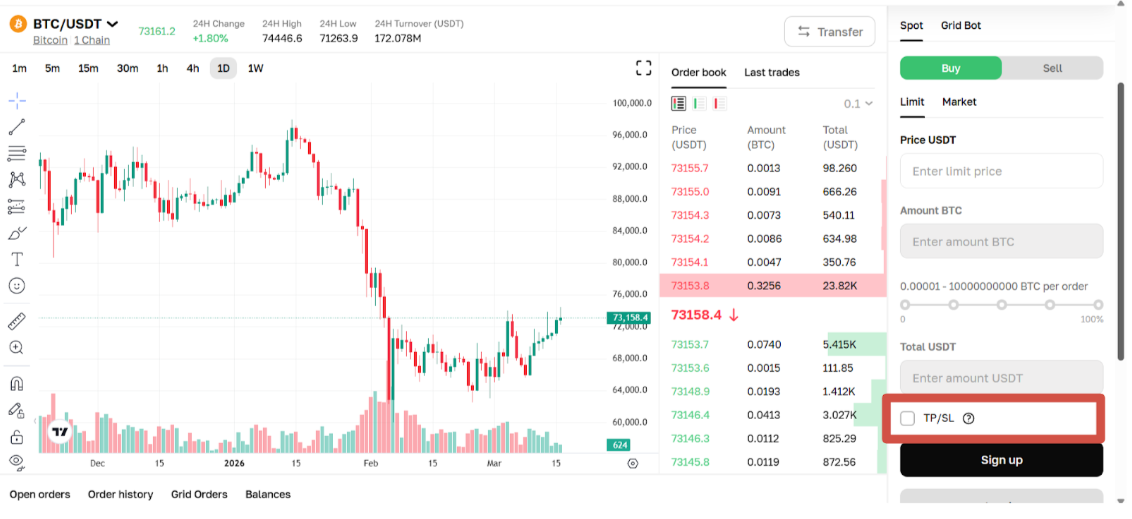
If you click it, two fields will appear. In one, you enter the price to lock in your profit, and in the other, the price to limit your losses. The system will immediately show you exactly how many you'll earn if everything goes according to plan.
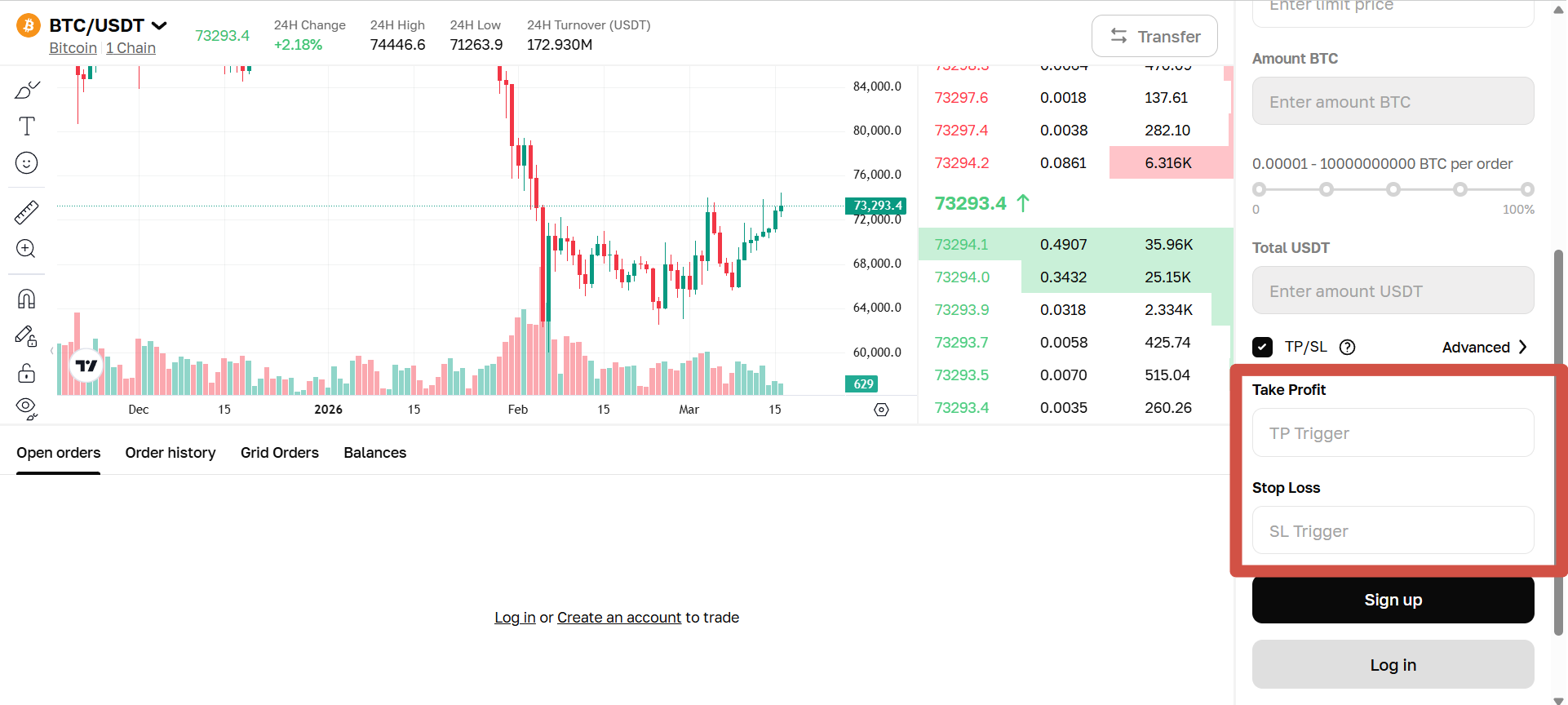
Example. Let's imagine you bought Bitcoin at the current price of approximately $75,000. To lock in your profit in advance, you set a take profit of $80,000—this is your target price, at which you want to exit the position with a profit. You can also set a stop-loss, for example, at $70,000, to limit potential losses if the market declines. In the TP/SL section, simply enter these values: $80,000 in the “Take Profit” field and $70,000 in the “Stop Loss” field. After this, the trade will be managed automatically—if the Bitcoin price rises to $80,000, the exchange will lock in your profit, and if the market begins to fall and reaches $70,000, the position will be closed to avoid significant losses.
How to Use Take-Profit in Trading?
For take-profit to be useful, you need to understand where and why you're setting it. There's a golden rule of risk-reward in trading: your potential profit should be at least two, and preferably three times, your potential loss.
Let's say you're willing to lose $10 on a trade if the price goes wrong (this is your stop-loss). In this case, your take-profit should be set to yield a profit of $20 or $30. Why is this important? Because with this math, you only need to close 40% of your trades in the black to ultimately grow your account. If you set tiny take-profits and huge stop-losses, one losing trade can wipe out the profit you've been accumulating for an entire month.
To find the right exit point, traders look at "levels". Think of the price as having a floor and a ceiling.
1. Ceiling (resistance level). This is the price above which the coin has historically struggled to rise. It's reasonable to place a take-profit order slightly below this level to ensure you have time to sell before other traders start dumping the asset en masse.
2. Floor (support level). This is where the price typically stops falling and begins to rise. Stop-loss orders are usually placed below this level.
It's also helpful to use a volatility indicator called ATR (Average True Range). It shows how many coins move on average per day.
Common Mistakes to Avoid
Even experienced traders sometimes make mistakes that turn a profitable strategy into a losing one. The main enemy here is our own emotions.
1. The first and most common mistake is "greed" and FOMO (fear of missing out). You see the price soaring; it's almost touching your take-profit, and suddenly you think, "Wow, it's going up! It's probably going to go up even more. I'll delete my take-profit!" You delete the order, and the price reverses a second later and plummets. Instead of profit, you end up with a loss or disappointment. Remember: a plan is made with a cool head, and changing it in the heat of the moment is a surefire way to lose money.
2. The second mistake is setting the take profit too close. Beginners often do this out of fear: they want to see the green number in their account as quickly as possible. But such short trades don't justify the exchange commission and the risks you're taking. On the other hand, too-distant targets are also dangerous—the price might miss them by just a few cents and reverse forever.
3. The third trap is ignoring the spread and liquidity. In the market, there's always a difference between the buy and sell prices. If you're trading coins with low liquidity, there may simply not be enough buyers at your price when your take-profit is triggered. The exchange will execute your order at the current price, which you might not like.
4. Also, many people forget to adjust their orders. The cryptocurrency market changes rapidly. If important news is released, support and resistance levels can shift. A static take-profit that was relevant yesterday may be either too low or unattainable today.
5. Finally, the most dangerous mistake is trading without a take-profit or stop-loss at all. Some trust their intuition and hope to close the trade manually. Automation is not a luxury but a necessity for anyone who wants to preserve their nerves and capital.
 Start trading affordable cryptocurrencies todayAccess low-priced cryptocurrencies, real-time charts, and fast order execution on Cryptomus. Trade trending coins with a user-friendly platform.
Take-profit teaches discipline, helps maintain a cool head, and, most importantly, gives you freedom. After all, the main goal of trading isn't to spend your entire life in front of a computer but to earn money so you can enjoy life outside the digital world. Preset goals are your ticket to the world of professional investing, where every action is justified and calculated.
We hope, after reading this article, you've learned what take-profit is in crypto trading. And if you still have questions, feel free to ask them in the comments!


